There’s a pattern I keep meeting in enterprise AI programmes. The demo lands. It’s genuinely impressive, and everyone in the room can see the future in it. The contract gets signed. Then somewhere around month four the thing still can’t read production data, and the steering committee deck has quietly started using the word “phased”.
Here’s the sentence nobody says out loud: the scope survives the pitch and dies in integration.
Not the AI. The AI is mostly fine. The models got good a while ago. What dies is everything the statement of work assumed was already there.
Where it actually dies
I’m scoping an invoice automation at the moment for a client whose business processes around 500,000 supplier invoices a month. The pitch version of that project fits on one slide: AI reads the invoices, matches them, posts them. Tidy.
The delivery version looks like this. Invoices arrive as PDFs, scans, email bodies, and the occasional photograph of a piece of paper. Some suppliers invoice in three different formats depending on which of their systems generated it. Matching means three-way matching against purchase orders and receipts that live in an ERP which grants API access the way a bank grants a home loan. When a match fails, and at half a million a month plenty will, the exception has to go somewhere, to someone, with enough context to resolve it in under a minute, and then it has to come back into the flow without breaking anything downstream. And the system doing all this has to act as somebody. Whose login? With whose approval? Under whose name in the audit log?
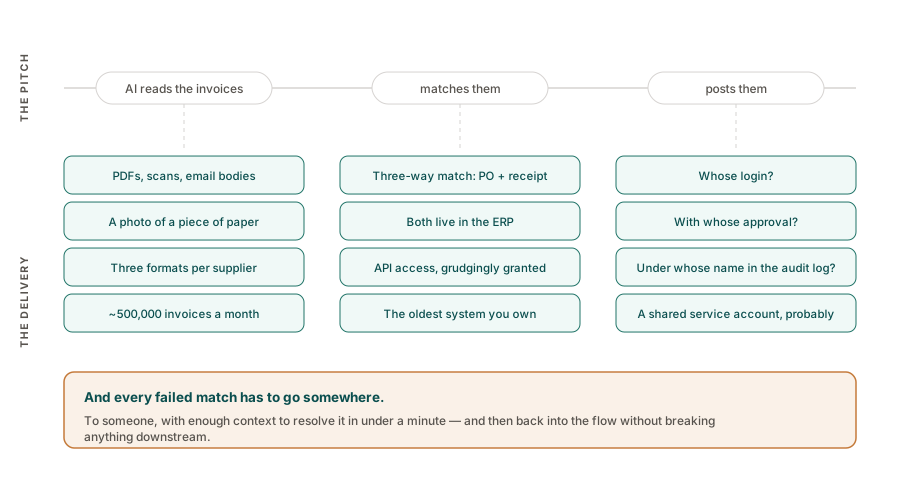
The pitch takes a slide. The delivery version is the project. Every one of those items was true before the vendor walked in, and none of them were in the demo.
Why nobody says so
Incentives, mostly. For the integrator, a change request is revenue, so there’s no commercial reason to scope the hard part upfront when it can be discovered later at a day rate. And the executive who signed doesn’t especially want to stand up and announce the scope was fiction. So the missing work gets renamed “phase two” and everyone politely agrees to be surprised later.
I don’t think anyone is lying. The demo is real. It just runs on the happy path, and the happy path was never the work. The work is the exceptions, the permissions, and the oldest system you own.
Five questions to ask before you sign
- Run the demo against our data, in our environment, under our permissions. Not the vendor sandbox. If this triggers a scheduling discussion rather than a date, you’ve learned something valuable for free.
- Walk me through one document it can’t handle, end to end. Where does it land, who touches it, and how does it get back into the flow?
- Whose credentials does the system act under, and who approved that? If the answer involves a shared service account nobody wants to discuss, keep asking.
- What exactly is in phase two? Then the harder version: does this contract still make sense if phase two never happens?
- Which line item covers integration with the oldest system we own? And who on the delivery team has integrated with it before. Names, not roles.
None of these are hostile. A good vendor answers them quickly and specifically, and you should hire that vendor. It’s the vague answers that are expensive.
The offer, stated flat
I do a 45-minute pressure-test of AI roadmaps and vendor proposals. You get a page in writing afterwards. If what’s in front of you is solid, I’ll tell you it’s solid, and that’s worth having in writing too. No charge for the call — get in touch and tell me what you’re being asked to sign.